
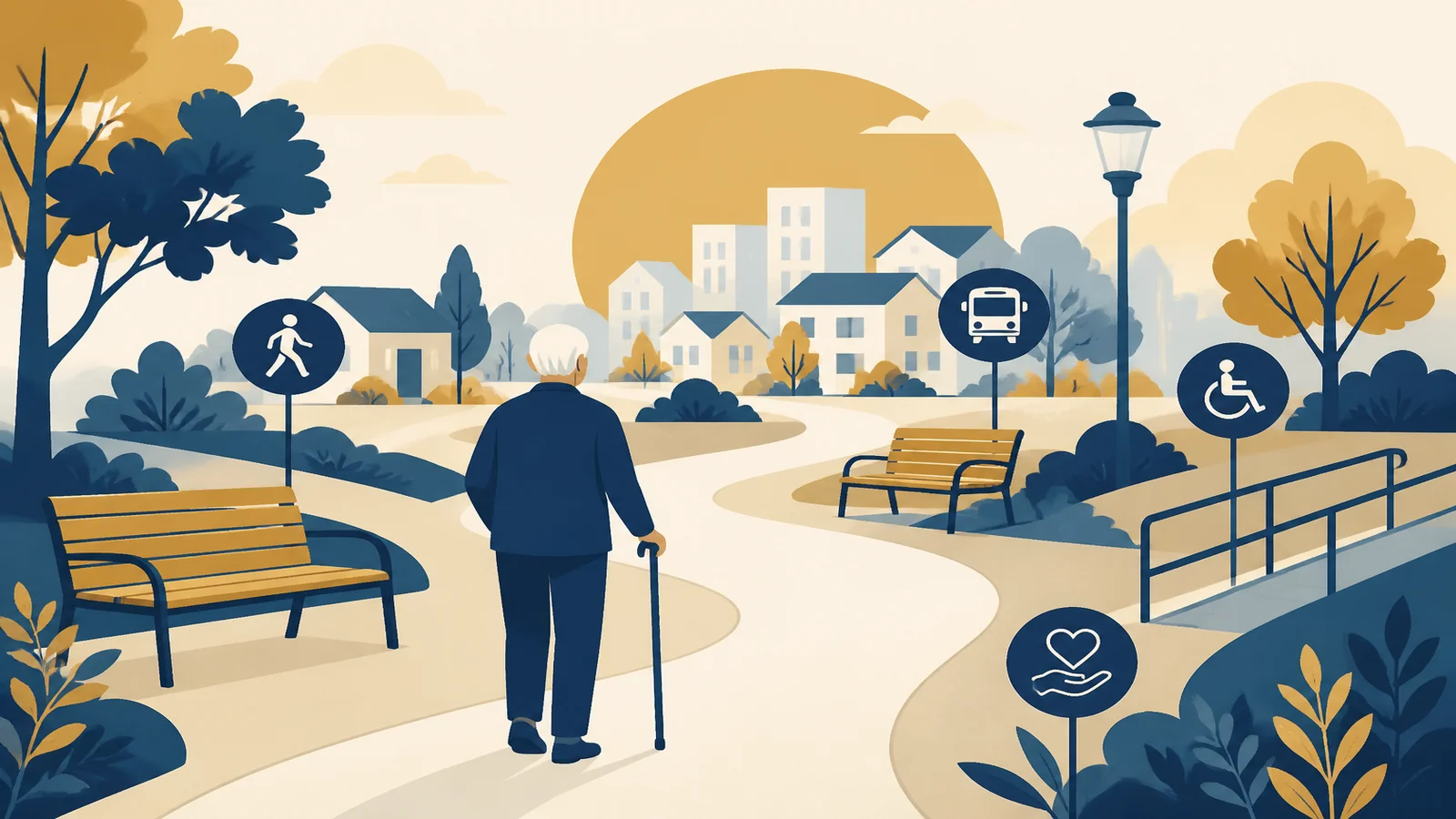
An age-friendly community does not ask older people to adapt alone; it makes places, information, services and communication clearer, easier and more respectful.
When everyday tasks become more difficult with age, we may assume the problem lies only in an individual’s ability. Yet part of the difficulty comes from design itself: small text, a complicated application, no nearby seat, a long procedure or language delivered too quickly for a person to understand comfortably.
The UAE National Policy for Senior Emiratis includes infrastructure, transport, participation, safety and future quality of life. This perspective encourages us to ask about the environment, not only the individual.
What does “age-friendly” mean?
It describes a place, service or community that reduces barriers people may encounter as they grow older. Expensive technology is not always required. Sometimes the difference is:
- A nearby seat.
- Better lighting.
- A larger sign.
- An employee who explains without hurry.
- A telephone option instead of a complicated digital-only route.
- A clearly visible text-size control.
Clear information is part of access
Even a person with full mobility may face a barrier when information is complex. Text can be improved through short sentences, clear headings, the removal of unnecessary terminology and steps presented in a logical order.
On a website, text should be zoomable, contrast should be strong and controls should be large enough. These practices also align with the UAE’s direction on digital accessibility.
Time is a design element
A senior citizen may need slightly more time to read a message or enter information. When a system closes the session quickly or returns to the first page, the process becomes exhausting.
Even in human communication, speed can become a barrier. Finishing someone’s sentence or repeating a question impatiently damages the experience more than it saves time.
Independence first
Good design does not assume that every senior citizen needs a companion. Anyone who wishes should be able to complete tasks independently, with support available when required.
This principle preserves dignity, prevents unnecessary dependence and improves the service for every age group.
Social spaces
An age-friendly community is not only about services. Senior citizens need places for meeting, activity, movement, learning and participation. Isolation is not an inevitable result of ageing; the social environment can reduce or increase it.
A community can organise:
- Dialogue gatherings.
- Suitable movement activities.
- Digital learning sessions.
- Intergenerational experience workshops.
- Reading or hobby clubs.
The role of the family and neighbourhood
Individuals can notice details that do not require an institutional decision. Is the home entrance safe? Is lighting sufficient? Is there a rug that may cause a fall? Can the senior citizen reach the information they need? Do we give them time to participate in conversation?
A neighbourhood can also become more supportive when neighbours know senior citizens and check on them respectfully, without intruding on privacy.
A useful rule: design for those who need more, and everyone benefits
Larger text helps a person with low vision, but it also helps someone reading in bright light. A clear button helps an older user and someone in a hurry. An extra seat helps a pregnant person, someone with a temporary injury and a senior citizen.
Inclusive design should therefore not be treated as a cost for a small group; many of its improvements raise the quality of experience for everyone.
How do we measure success?
Instead of asking “Did we provide a service for senior citizens?”, it is better to ask:
- Can they use it independently?
- Do they understand the information?
- Do they feel respected?
- Is there space for participation?
- Does it reduce reliance on others for tasks they can complete themselves?
An age-friendly community is ultimately a community friendly to people at every stage of life. What we design today for someone in their sixties or seventies may be exactly what we need tomorrow.
Official references
- National Policy for Senior Emiratis – The Official Portal of the UAE Government. https://u.ae/en/about-the-uae/strategies-initiatives-and-awards/policies/social-affairs/the-national-policy-for-senior-emiratis
- Senior Emiratis in the UAE – The Official Portal of the UAE Government. https://u.ae/en/information-and-services/social-affairs/senior-emiratis
- Bridging the Digital Divide and Digital Accessibility – The Official Portal of the UAE Government. https://u.ae/en/about-the-uae/digital-uae/digital-inclusion/bridging-digital-divide
Reference links were checked during package preparation on 25 August 2026. If a policy or link changes, the official source remains the most up-to-date reference.