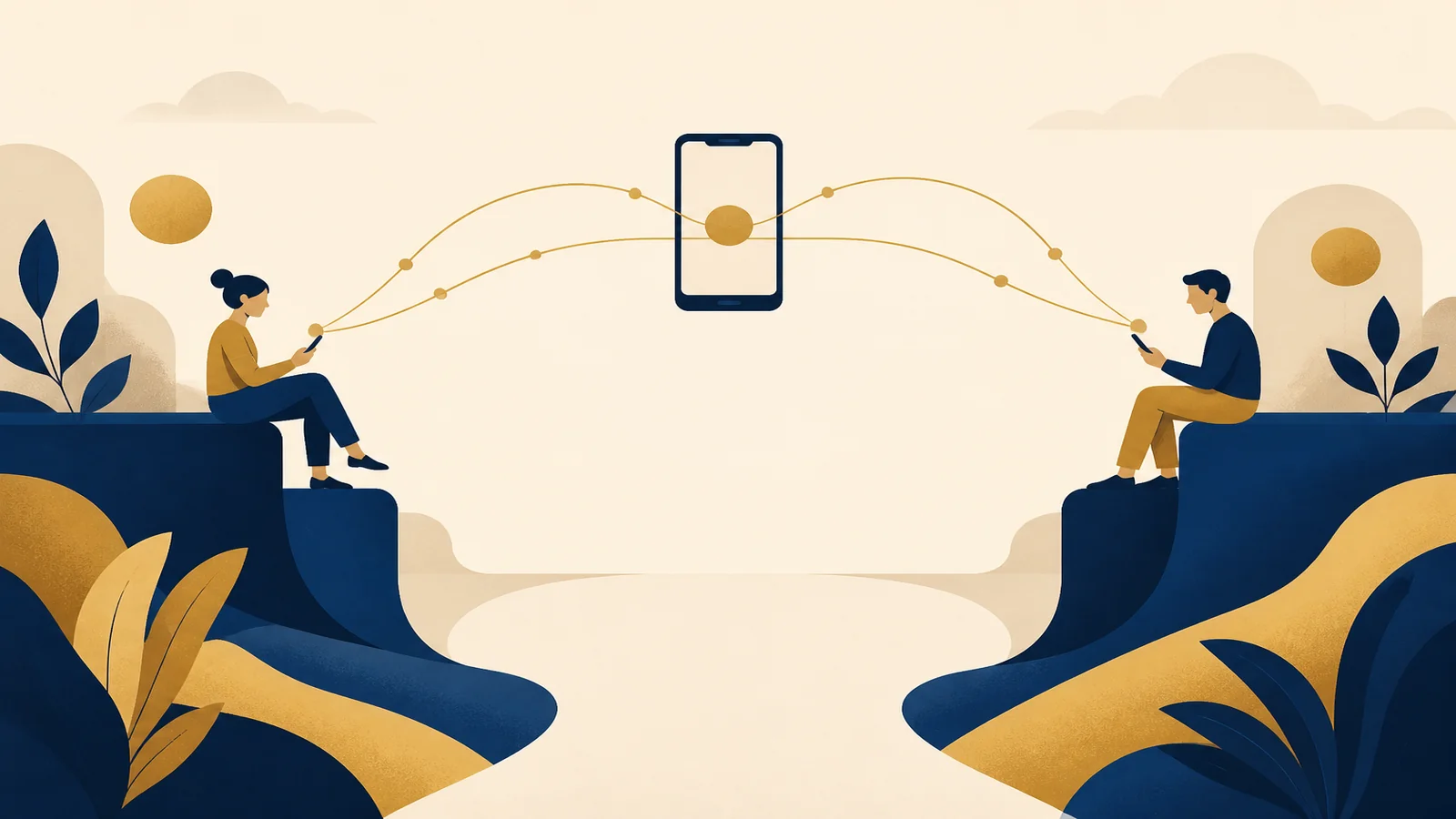
Technology can bring distant people closer, but it can distance those nearby when we do not set conscious boundaries. The issue is not the device alone, but the place it occupies in our relationships.
Today we can see a relative in another country within seconds, learn from a distant expert and communicate with an entire group at once. From that perspective, technology has connected us in an unprecedented way.
At the same time, many of us know another scene: four people around one table, each inside a different screen. Is that a contradiction, or does technology simply amplify the way we choose to use it?
The UAE National Policy for Quality of Digital Life does not call for retreating from technology. It promotes safe, positive and balanced use. That leads to the more mature question: how do we keep the benefits of connection without losing the quality of presence?
A lot of contact, little conversation
The number of messages does not equal the depth of a relationship. We may exchange dozens of messages with someone every day without speaking about what we actually feel. Fast communication is excellent for coordination, but it cannot replace every form of dialogue.
Technology can begin a relationship rather than end it: a message to check on someone followed by a call, a family group that arranges a visit, or an old photograph that opens a story.
Attention is a limited resource
Every notification asks for part of our attention. When the phone is allowed to interrupt every moment, the people around us receive an unintended message: something else can always be more important than you.
The solution does not require switching the phone off for hours. We can begin with protected places or times:
- The first twenty minutes after returning home.
- A main meal.
- While someone is discussing something important.
- The final half-hour before sleep.
Presence does not mean rejecting technology
A shared screen can bring people together: watching a film, learning, reviewing family photographs or playing a group game. The difference is that technology serves a shared activity instead of isolating everyone in a separate stream.
Relationships need non-digital signals
A visit, a walk, a handwritten gift, a gathering, a volunteering activity or coffee together carries human signals that a screen cannot fully transmit: tone, silence, eye contact and physical presence.
It is worth asking: when did I last spend time with someone I care about without making the phone the centre of the meeting?
Constant comparison
Technology affects more than time; it affects the picture through which we see our own lives. Platforms display selected moments. When we compare an ordinary day with other people’s best moments, we may feel less successful or less happy.
Understanding that what we see has been edited helps us recover a more realistic perspective.
Family and balance
The Year of the Family 2026 emphasises connection, presence and daily practices. A family can write a simple one-page “digital agreement” covering:
- Device-free times.
- Respect for privacy.
- Not sharing family photographs without consent.
- Asking for help when a problem occurs.
- Not using phones during a serious conversation.
The agreement should apply to adults as well as children.
Technology is a tool, but habit is a decision
I do not believe the right question is “Is technology good or bad?” It is a powerful tool that can open knowledge and connection or create distraction and isolation.
A better question is: does the way I use technology today bring me closer to the people and values I say are important to me?
When the answer is no, we do not need to declare war on devices. We need to adjust habits. Sometimes it is enough to turn the phone face down and look at the person in front of us.
Official references
- National Policy for Quality of Digital Life – The Official Portal of the UAE Government. https://u.ae/en/about-the-uae/strategies-initiatives-and-awards/policies/government-services-and-digital-transformation/national-policy-for-quality-of-digital-life
- National Strategy for Wellbeing 2031 – The Official Portal of the UAE Government. https://u.ae/en/about-the-uae/strategies-initiatives-and-awards/strategies-plans-and-visions/social-affairs/national-strategy-for-wellbeing-2031
- Year of the Family 2026 – The Official Portal of the UAE Government. https://u.ae/en/Year-of-family/Family-year-2026
Reference links were checked during package preparation on 25 August 2026. If a policy or link changes, the official source remains the most up-to-date reference.